Matriz del Destino vs Birth Chart: Differences and Which to Choose
 Arcania Team 4 min read
 If you’re exploring self-knowledge tools, chances are you’ve come across both the Matriz del Destino and the astrological birth chart. Both promise something similar — understanding yourself better from your birth data — but they start from completely different systems. Here we honestly compare what each one does, how they differ, and which suits what you’re looking for.
What each system is
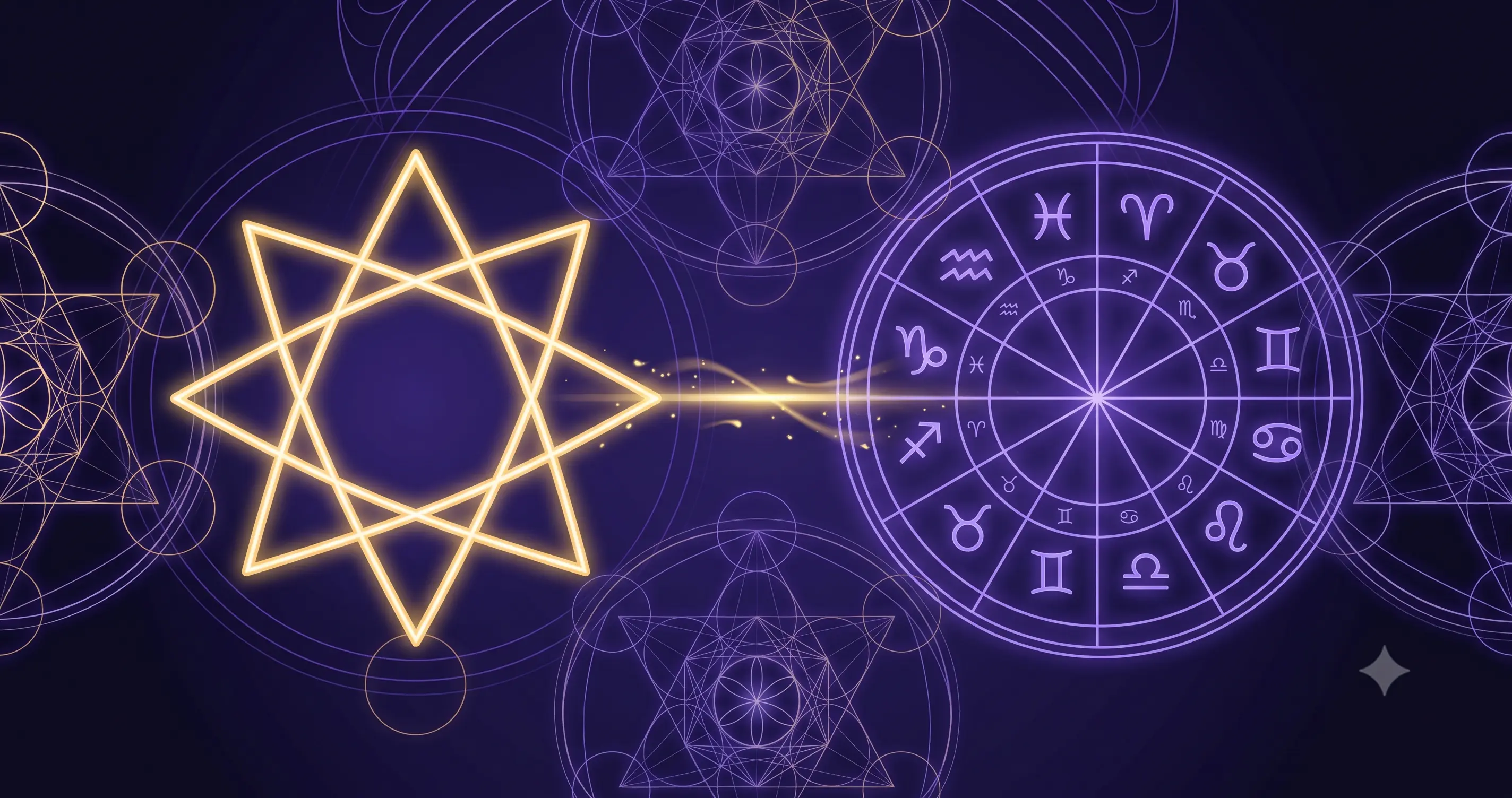
The Matriz del Destino is a numerological system developed in 2006 that turns your date of birth — day, month, and year, with no need for time or place — into a diagram called the octagram. Each position in the octagram is calculated mathematically by adding and reducing those numbers, and represents a different dimension of your life: personality, talents, mission, relationship with money, inherited family patterns, among others.
The birth chart, by contrast, is an astrological map that records the exact position of the planets, the sun, and the moon at the precise moment of your birth, requiring your date, exact time, and place of birth. It’s a system with thousands of years of development, far more complex in its calculation and interpretation, describing personality tendencies, relational patterns, and life cycles based on the real astronomical position of the celestial bodies.
What data each one needs
Here’s one of the most important practical differences: the Matriz del Destino only needs your complete date of birth, nothing else. You can calculate yours in seconds without needing to remember the exact time you were born, something many people simply don’t know precisely. The birth chart, on the other hand, depends critically on the exact time: without it, key positions like the ascendant and the astrological houses can’t be calculated accurately, which seriously limits the reading.
Depth and complexity of interpretation
The birth chart offers enormous depth: it combines twelve signs, ten planets, twelve houses, and dozens of aspects between them, making it a system with thousands of possible combinations and a considerable learning curve. Interpreting it competently usually requires years of study or the guidance of a professional astrologer.
The Matriz del Destino, by contrast, works with a more contained structure: 22 possible arcana distributed across a fixed number of positions. This makes it considerably more accessible for someone just starting to explore self-knowledge, without that making it shallow: every position carries real nuance, and positions like the karmic tail or Point E offer readings just as specific as an astrological aspect.
Which one suits what you’re looking for
If this is your first approach to self-knowledge through your date of birth, or if you don’t have your exact birth time, the Matriz del Destino is a much simpler and quicker entry point: a complete, free, instant result. If, on the other hand, you’re looking for an extremely detailed reading of temporal cycles, planetary transits, or complex astrological compatibilities, and you have your exact birth time, the birth chart offers a level of detail the matrix doesn’t try to replicate.
They aren’t competing systems: they’re complementary. Many people use the Matriz del Destino as a first clear snapshot of their personality and purpose, then go deeper with a birth chart if they want to explore finer temporal or relational dimensions.
Why the Matriz del Destino is a good starting point
Beyond the comparison, there’s a practical reason to start here: you don’t need any hard-to-find data, the result is immediate, and it doesn’t depend on someone else interpreting your diagram for you — the reading for each position is there for you to explore at your own pace. You can calculate your Matriz del Destino for free right now with just your date of birth and see your complete octagram in under a minute.
Arcania Team
We're a team passionate about self-knowledge and spiritual numerology. We combine the Matriz del Destino method with accessible interpretations to help you discover your life purpose.